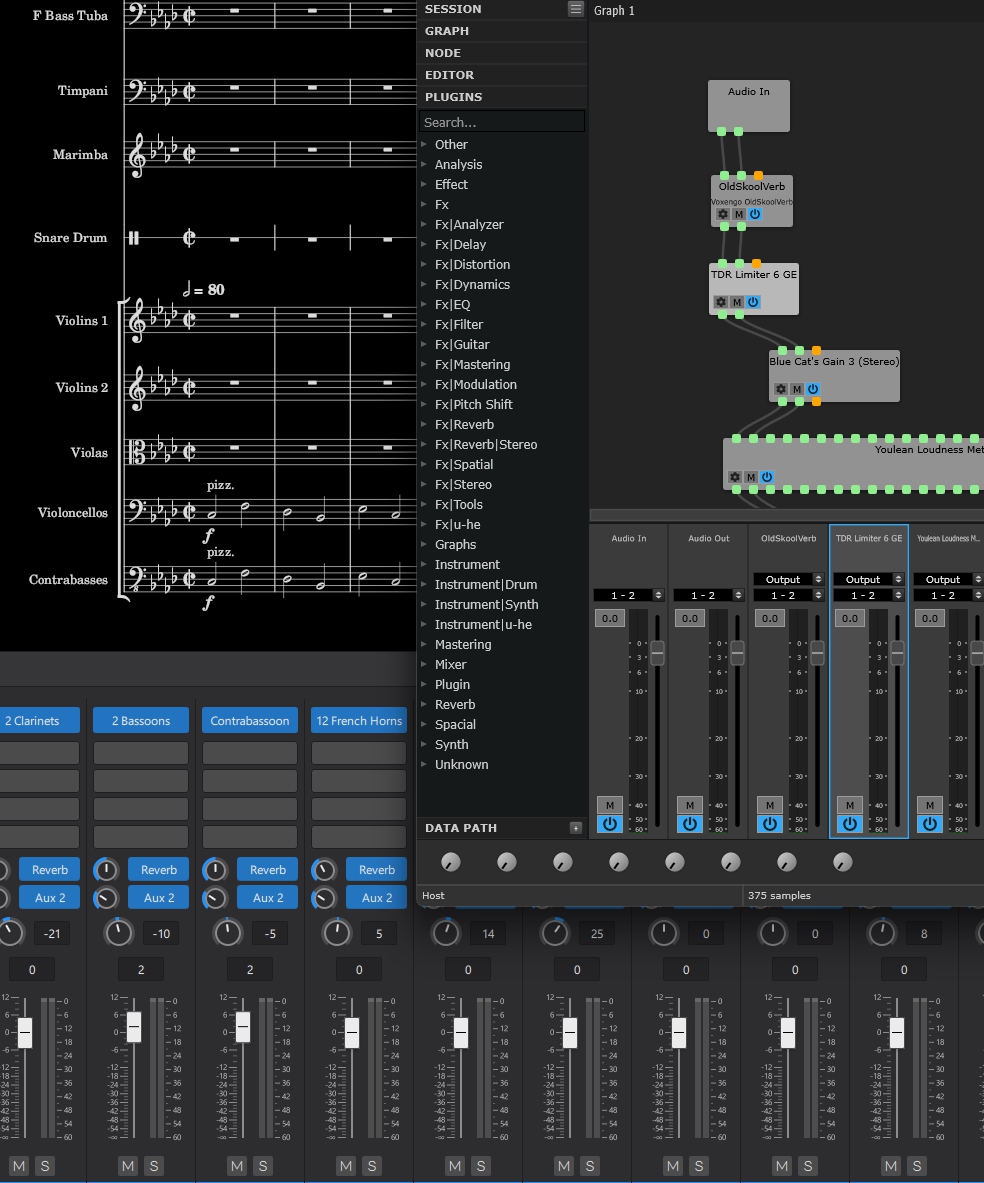
Since I studied music and always write a score, my compositions are created and developed primarily in MuseScore 4, using professional sound libraries from companies such as Vienna, Spitfire, MGM Cinematic, Berlin, and MuseHub. For the final production stage, I used to export the individual instrumental tracks as audio files and continue working with them in Cakewalk Sonar or Reaper on the Mac, where I handled the mixing, EQ, spatial placement, reverb, dynamics, and final mastering.
This workflow allowed me to combine the precision of notation-based composition with the flexibility of a full digital audio workstation. MuseScore was the environment in which the music itself was shaped, while Cakewalk Sonar became the final studio — the place where the individual voices were brought together and refined into a finished recording.
More recently, however, MuseScore 4 has evolved far beyond its traditional role as a notation program. Its increasingly sophisticated playback and mixing environment, support for audio effects, and especially its ability to work with external plugins have gradually transformed it into a much more complete production environment.
By expanding MuseScore with Element, I can create more elaborate effects chains and integrate multiple plugins directly into my workflow, giving me considerably greater control over the sound without leaving the score. EQ, compression, reverb, spatial processing, dynamics, and other effects can now become an integral part of the production process while I am still composing, orchestrating, and shaping the musical interpretation.
This has significantly changed the way I work. The boundary between composition, notation, performance, and production has become increasingly fluid: instead of treating the score and the final recording as two separate stages, I can now develop much of the finished sound alongside the music itself. Cakewalk Sonar remains a powerful option when a project calls for a dedicated DAW, but an increasing part of my production can now take place entirely within MuseScore.